An interactive tool at multiple scales
Mona and Kaicheng viewed longevity through an urban design lens, examining academic studies, international precedents, demographic trends, and age-friendly planning frameworks, including the World Health Organization’s eight domains of age-friendly communities. Recognizing that older adults are not a homogeneous group, they also explored how the experience of aging differs across urban and suburban contexts. Mona attended the Bloomberg CityLab 2026 summit in Barcelona, and, along with conversations at the summit, she was able to experience firsthand how Barcelona’s public spaces, neighborhood infrastructure, mobility, and everyday social life combine.
As they synthesized these perspectives, one question kept arising: “How do we make this knowledge useful to designers, planners, and communities?” They wanted to create an interactive tool to encourage people to engage with research, question assumptions, and explore different solutions together. They also wanted to encompass a variety of scales, from an individual routine to the systems that support it. They were particularly interested in understanding how housing, mobility, public spaces, social participation, and access to services influence people’s ability to age independently and remain connected to their communities.
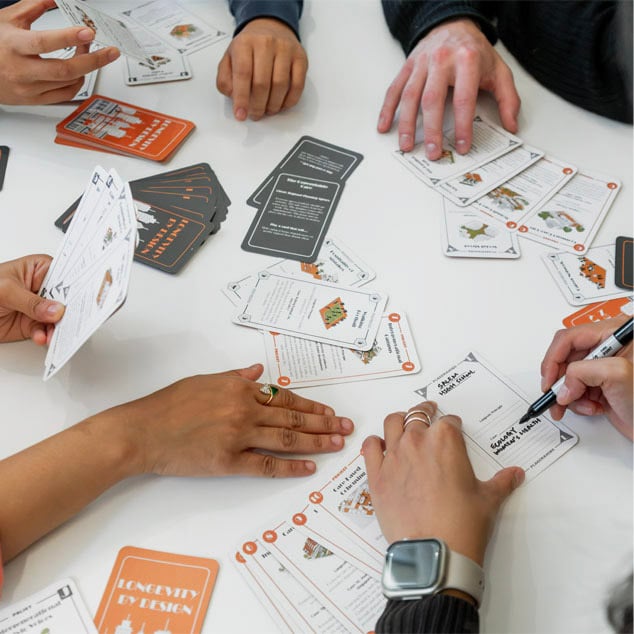
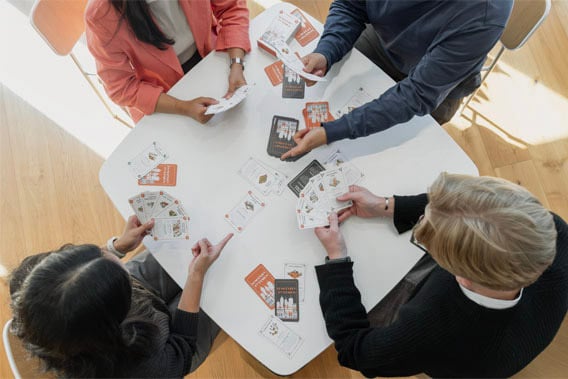
That led them to develop the Longevity Playbook, a 52-card participatory design toolkit organized around four planning lenses: policy, program, project, and placemaking.
They translated their research into playing cards that allow participants to respond to real-world planning scenarios by selecting different interventions, discussing priorities, and developing integrated strategies. The format encourages conversations about trade-offs and demonstrates that designing for longevity rarely involves a single solution. At the University of Michigan’s school of architecture, Kaicheng tested the format with more than 30 students in two courses, which exposed the students to new ways of approaching design challenges and allowed the researchers to learn more about the toolkit’s function and usefulness.
Comprehensive improvements with broad benefits
They found that truly improving mobility for older adults typically requires holistic approaches rather than isolated interventions like sidewalk improvements. “One of our most surprising realizations was how much attention we give to aging populations without necessarily connecting that conversation to the physical environments in which people age,” Mona says. “Issues like senior housing, accessibility, transportation, and social services are often addressed separately, even though people’s experiences of a city depend on how all these systems work together.” They found that the benefits can be broader, too: Comprehensive improvements to these systems benefit not only seniors, but everyone who lives in or visits a city.